‘Deliberate Assassination’: Baltimore Man Sentenced to Life Without Parole in Essex Shooting
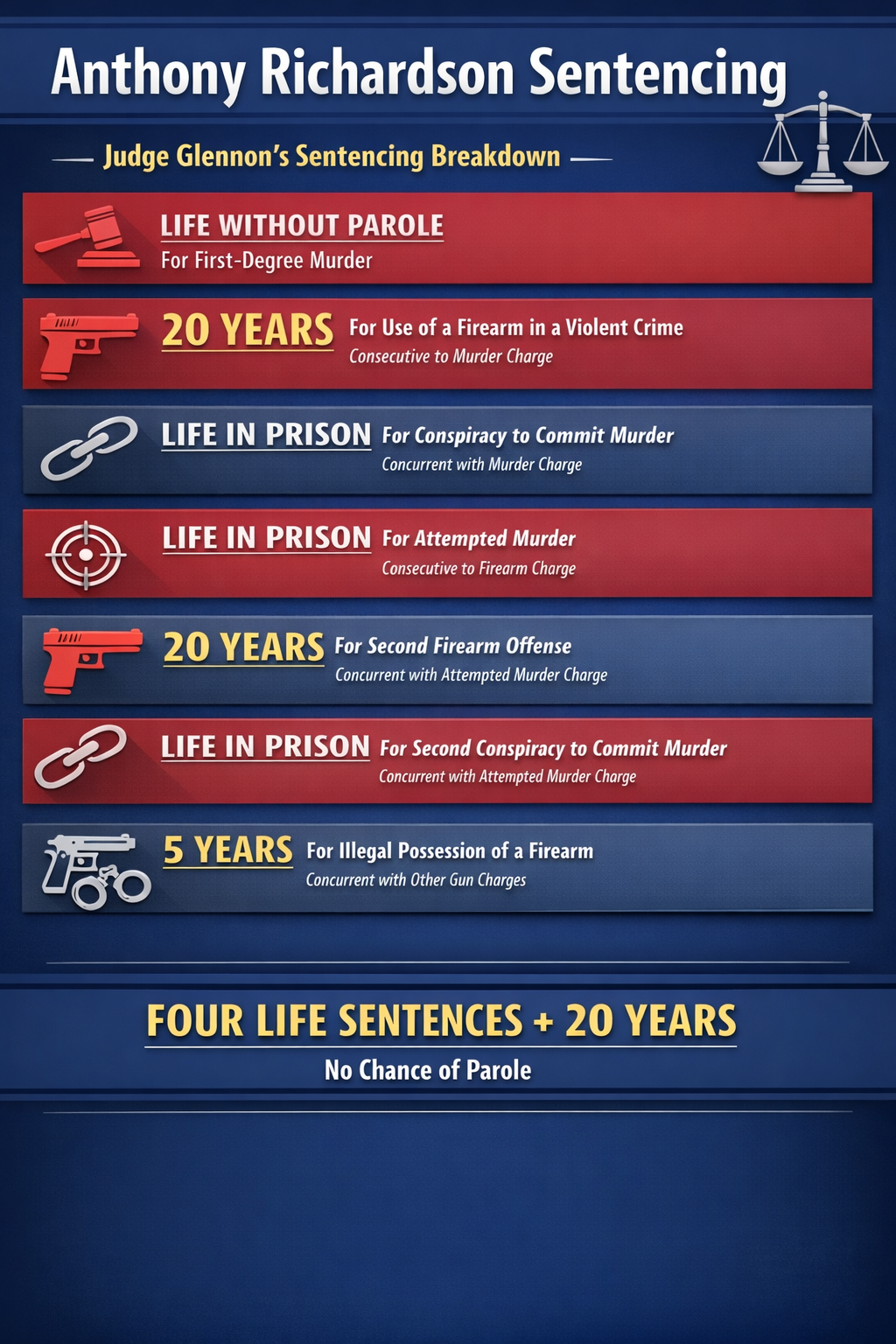
ESSEX— A Baltimore man was sentenced to life without the possibility of parole plus 20 years in prison Friday for what prosecutors called the deliberate daytime assassination of 22-year-old Philip Pasingda and the non-fatal shooting of another man.
A Baltimore County jury in May found Anthony Richardson, 24, guilty of one count of first-degree murder, two counts of conspiracy to commit murder, one count of attempted murder and related weapons offenses.
Philip Pasingda was shot eight times November 22, 2023, on the unit block of Glenwood Road and died at Hopkins Bayview Medical Center shortly after the shooting. Kayvon Grant, 21, was also shot in the incident and survived his injuries.
“This was a deliberate assassination perpetrated in broad daylight in a densely populated residential community,” said Assistant State’s Attorney Ryan Fish. “It was preplanned to achieve maximum surprise.”
Police said Richardson and two co-defendants jumped out of a car and used handguns modified to be fully automatic, firing 37 rounds in less than four seconds.
“The fact that only two people were struck by this barrage is nothing short of miraculous,” Fish said.
In total, Richardson received four life sentences, with 20 years added consecutively, ensuring he will spend the rest of his life in prison unless he wins an appeal.
Co-defendant Xavier Nettles, 25, was tried in February 2025 and found guilty of murder, conspiracy to commit murder, attempted murder and other related charges. Circuit Court Judge Garret Glennon sentenced Nettles to two life concurrent sentences plus 50 years.
A third defendant, Travell Allen, 27, of Essex, has a bench trial scheduled for late August.
Judge Glennon’s voice wavered with emotion as he spoke about the brutality of the crime.
“It was about as violent as violence gets,” Glennon said.
Richardson addressed the judge at his sentencing, insisting he had nothing to do with the shooting and asking Glennon for leniency.
"Today, two families are losing everything,” Richardson said, reading from a prepared statement, “the victim’s family, as well as my family. I cannot stress enough that nobody’s family should go through this. And the fact that I did not know the victim makes it even more hard because I'm being punished for something I truly didn't do.”
Glennon said there was ample evidence of Richardson’s guilt, including surveillance video, cell site data and social media posts. Glennon said he was disturbed by videos Richardson and his co-defendants made after the shooting showing the “glorification of guns, crime, and violence.”
“The jurors and I could see the defendants dancing, rapping, flaunting their arsenal of weapons with drum magazines and laser sights,” Glennon said. He said the men in the videos were celebrating obtaining conversion mechanisms that turned handguns into fully automatic machine guns.
Richardson has a lengthy criminal history, beginning as a juvenile and including a three-year prison sentence for a weapons offense.
Glennon said the sentences should send a message that this type of violent behavior will not be tolerated.
“No lesser sentence will deter this defendant from reoffending,” Glennon said.